

All workeCommerce · AISince 2012
Fun Cases
- The brief
- Fun Cases had outgrown its old brand, and the third-party app customers used to design their own cases cost nearly £5,000 a year.
- What we did
- We rebranded the business, starting with the logo, and built a new Shopify theme from scratch with our own personaliser in it. We also run their SEO, paid ads and email marketing, and we built the custom software they run stock, shipping, printing, returns and customer service from.
- Results
- Revenue is up 300% over the last five years. Email brings in 30% of revenue, AI triage has cut customer service hours by 70%, and their custom software saves about 20 hours of work a day.
- +300%
Revenue growthover 5 years
- 30%
Revenue from emailof total revenue
- −70%
Customer service hourswith AI triage

Background
Fun Cases ship thousands of phone cases a week from a catalogue of over 20,000 designs, and we've run their eCommerce since 2012, before we were called Webgro. The most recent project was a full rebrand and a new Shopify theme built from scratch, including a custom product personaliser that replaced a paid third-party app. Revenue is up 300% over the last five years.
Part 1 of 3
Rebrand & Website
A full rebrand (logo, tone of voice, social, email) and a new Shopify theme built from scratch, with a custom personaliser that replaced a £5,000-a-year app.
The rebrand
A new brand across every channel
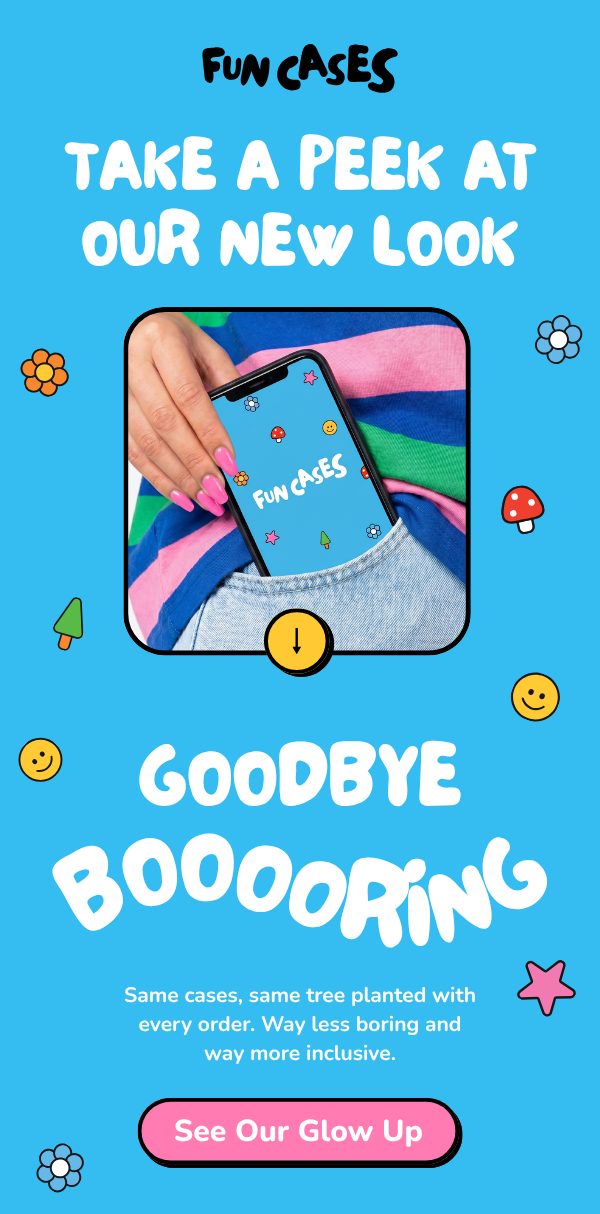
Fun Cases had outgrown its old look. We rebuilt the brand starting with the logo: a bold pop-art identity, a new tone of voice, and a design system of rounded blocks, ink outlines and a colour palette chosen to feel fun. Some things stayed the same, including the promise that every order plants a tree.
The website, social templates and a new email marketing system in Klaviyo all launched at the same time, so every channel moved to the new brand together.

The theme
A new theme for a 20,000-product catalogue
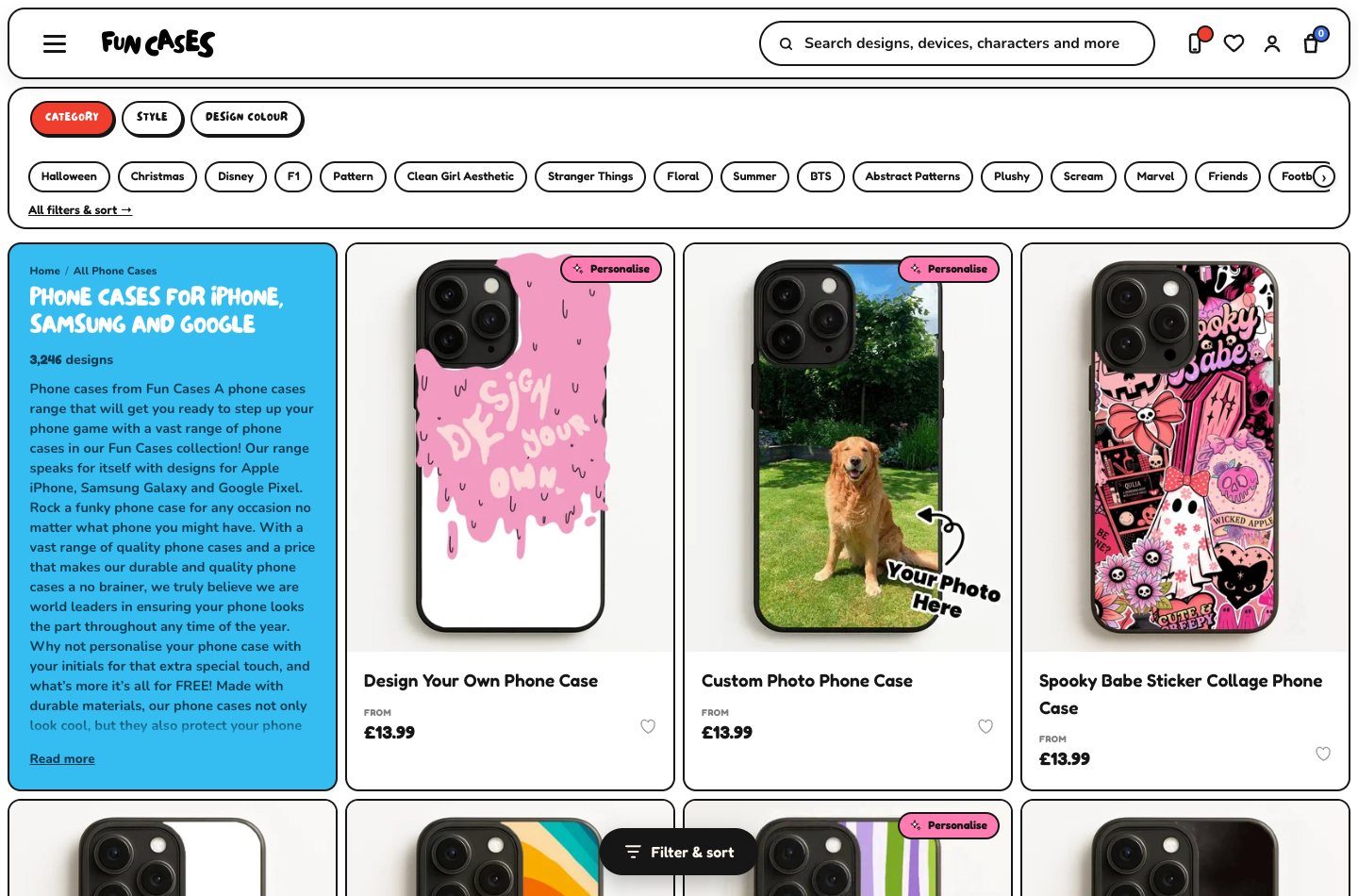
We built the new theme from scratch around how people shop for phone cases. It has a mega menu with trending collections and products, predictive search, a native wishlist, and a slide-out cart that shows progress towards free shipping and a free gift.
Every section can be edited in the theme editor and the colour palette is a theme setting, so the in-house team can restyle or rearrange pages without a developer.

Phone model selector
Choose your phone model once
With 20,000 designs, customers shouldn't have to check compatibility on every product. The site asks for their phone model once and remembers it. From then on, every product image in collections, search results and product pages shows the case on that exact phone.
This removes the biggest source of doubt when buying a phone case: whether the design the customer likes will fit the phone they own.
The personaliser
A custom case designer built into the theme
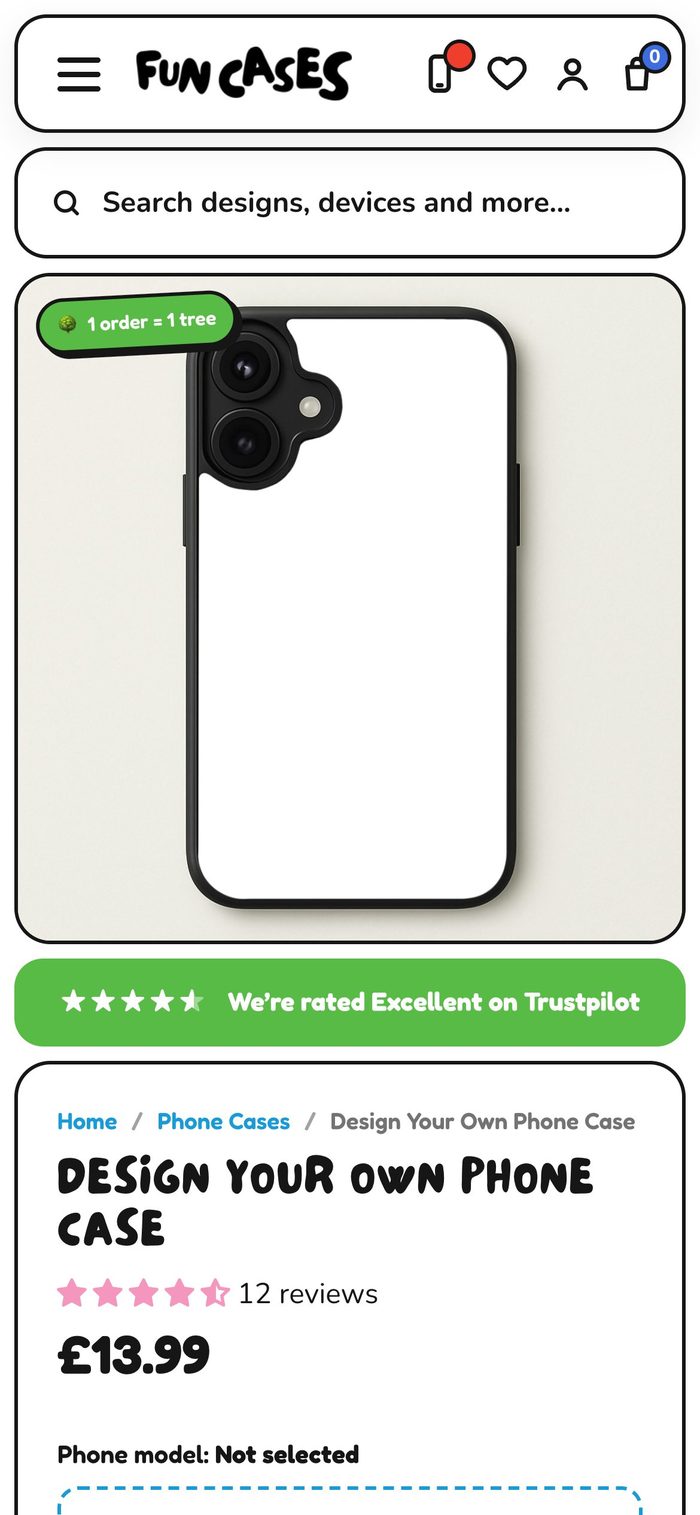
Custom cases are a large part of the business. The previous design tool was a third-party app costing nearly £5,000 a year. We replaced it with our own full-screen editor, built into the theme, where customers add photos, text and stickers to a live mockup of their exact phone and case type.
The editor adds a print-ready file to the order, so the studio prints exactly what the customer approved. There's no monthly fee or third-party checkout script, and Fun Cases own the tool outright.

Results
- £5k
App cost savedper year
- +300%
Revenue growthover 5 years
- 6.0%
Average conversion rateworldwide
- 11.2%
Peak conversion ratebest day, Dec 2025

Part 2 of 3
Marketing & SEO
Paid search, paid social, email and organic search, built on technical SEO that Google and LLMs can read easily.
SEO
Ranked #1 for 'Phone Cases'
We built SEO into the rebuild from the start: content architecture, internal linking, technical foundations, and a content programme tied to the merchandising calendar.
Fun Cases have since reached #1 on Google UK for 'Phone Cases', one of the most competitive category terms in the market.
Results
- 30%
Revenue from emailof total revenue
- £35k
Monthly paid spendacross Google and Meta
- 8+
Blended ROASsustained
Email marketing
Over 30% of revenue from email
Email brings in more for its cost than any other channel Fun Cases use. We run lifecycle flows in Klaviyo, design campaigns around the product drop calendar, and segment customers on what they do rather than on vanity fields.
Over 30% of total revenue now comes through email, and that revenue doesn't depend on extra ad spend.
PPC
£35k a month on Google and Meta
We run paid media on Google and Meta, with combined spend of around £35,000 a month and blended ROAS consistently above 8. Search, Shopping, Performance Max and paid social campaigns are all optimised against product margins rather than top-line revenue alone.
We manage the spend week to week as the catalogue grows.
Part 3 of 3
Custom Software
Ten tools behind one login, covering stock, the warehouse, shipping, printing, returns, content and customer service. The software saves about 20 hours of work a day.
In this section
- Ten tools behind one login
- Stock levels and purchase orders
- A warehouse system on handheld scanners
- A forecast that shows its working
- A Royal Mail label from one scan
- One button for each group of orders
- A returns portal and a returns desk
- Social content, checked and scheduled
- Artwork fitted to the right print shape
- New designs, from a brief to Shopify
- A helpdesk that replaced Freshdesk
- Case Club, a loyalty app
Custom software
Ten tools behind one login
Fun Cases run their stock, warehouse, shipping, printing, returns, content and customer service from one piece of software we built for them. Each person has their own login, with a role and access to only the tools they need. Several of the tools started as separate apps and were brought under the one login later, with their data.
The software saves Fun Cases about 20 hours of work a day, worth more than £30,000 a year. The screens in this chapter are example screens, redrawn with sample data.
Results
- 20 hours
Saved by the softwareof work a day
- 10
Toolsbehind one login
- −70%
Customer service hourswith AI triage
Stock management
Stock levels and purchase orders
The planning screens show what's in stock, what's on order and what has run out, and hold every purchase order. They read the warehouse records directly, so there's no copy of the data and no sync to wait for. The buyer and the owner use them.
The overview shows units in stock, stock value at cost, low and out-of-stock lines and the top movers of the last 7 days. A purchase order can be written by hand, imported from a CSV file or generated from the forecast, and an order that hasn't arrived shows as stock on order everywhere else.
Warehouse management
A warehouse system on handheld scanners
Off-the-shelf warehouse software was either too big or too limited for Fun Cases, so we built their own. Warehouse staff use it all day on rugged Android phones with barcode scanners, to book stock in, move it, find it, pick orders and run stock takes. Every scan records a stock movement and updates the stock held at each location. Booking in is three steps: the SKU, the location and the quantity.
Each scan is saved on the device before it's sent, and sent again if the wifi drops. A note is added to the Shopify order when it's picked, pressed and packed. Timekeeping is built in, with a points score for picks, book-ins, moves and stock takes.
The warehouse system was moved across from an earlier custom app. Every record kept its original ID, so the QR codes already on shelves and boxes carried on working.
Stock forecasting
A forecast that shows its working
The forecast works out what to order from each supplier and how much. It's a statistical calculation based on the units that left stock in the last 30 days, read from the warehouse movement log. The buyer picks a supplier, a delivery date and how many days of cover they want.
One-off adjustments of 50 units or more are left out. If a SKU was out of stock for part of the period, its daily rate is worked out over the days it was in stock. Seasonality is twelve monthly figures the buyer enters by hand, and quantities are rounded up to whole packs. Every number is shown, and any line can be changed before the order is created.
A stock cover page runs the same calculation forward for 12 months to show when each SKU will run out. An accuracy page compares each forecast with what was used afterwards.
Shipping labels
A Royal Mail label from one scan
A packer scans an order number at the bench. The software reads the order from Shopify, and a set of rules decides the size and service from the product type, the shipping method chosen at checkout and the delivery country.
The label is created through Royal Mail Click & Drop and sent straight to the bench label printer. The order is then fulfilled in Shopify with its tracking number. Scanning an order that has already been dispatched never buys a second label.
Print runs
One button for each group of orders
The software sorts the open orders into groups such as next day, express and standard, oldest first. The print operator presses one button for a group. Nothing prints by itself when an order arrives.
After that press the software builds every picking slip and design sheet from the workshop's existing print templates, picks the printer that will be free soonest and sends the job. A batch is joined into one file for each printer, with the slips and the designs in the same order so the two stacks match. Once the printer confirms, the order is tagged as printed in Shopify.
Returns
A returns portal and a returns desk
Customers book a return on a portal. They enter their order number and postcode, pick the items and a reason, and choose how to settle it: keep the item for a partial refund, send it back with a Royal Mail label, or post it back themselves. The portal replaced an older returns page.
The warehouse scans the parcel when it arrives, sees what should be inside and confirms or rejects it. Confirming refunds the customer in Shopify and puts the stock back. Customer service work from a list of every return, with its status and history.
Content and social
Social content, checked and scheduled
The team make social content in the same software and schedule it to Instagram. For text graphics, someone writes a brief and Claude returns the copy for a batch of up to 14. A fit checker measures every piece of text, and a claims check makes sure each price, percentage and promise matches a Facts table the team maintains. A graphic that fails waits for a person to review it.
For lifestyle images, staff upload product photos and Google's Gemini model builds a new scene around them, with the product left as it is. Approved content is dragged onto a feed grid or a stories row, and the queue posts at the set times through the Instagram API.
Resizer
Artwork fitted to the right print shape
The resizer takes the artwork from an order, fits it to the print shape for that phone model and case type, and sends a 300dpi print file to the workshop printers. Whoever is preparing personalised, one-off or reprint artwork for the press uses it.
Each phone model has a mask with its real size in millimetres. The match has to be exact: if the resizer isn't sure which mask applies, it picks none and offers suggestions. The print file carries the order number, the SKU, the mask name and whether the print is mirrored.
Product generation
New designs, from a brief to Shopify
A run starts from reference photos, a written brief or researched trending ideas. Claude writes a brief for each design and Google's Gemini model renders it.
A person picks the designs worth keeping and approves each one's name, SKU, category and tags. A queue then creates the products in Shopify with their titles, descriptions, variants and mockup images.
Helpdesk
A helpdesk that replaced Freshdesk
Emails, contact form messages and Instagram messages arrive as tickets, with the customer's Shopify order beside each one. An AI assistant sorts every new ticket. It reads the live order and the knowledge base, then writes a summary, a suggested next step and a priority score for the person handling it.
A member of the team reads the ticket and replies. From the same screen they can refund items, send a free replacement, put the order on hold or create a single-use goodwill code. The assistant never carries out refunds, replacements or order changes, and automatic replies are off unless the team switches them on.
Customer service hours are down 70% and customer satisfaction has improved.
Loyalty app
Case Club, a loyalty app
Case Club is Fun Cases' loyalty scheme, which we built as a custom Shopify app. Shoppers earn coins on every paid order, and for reviews, follows, birthdays and referring a friend. In their account they see their balance and cash coins in for a one-time discount code. Refunds and cancelled orders take the coins back.
Staff run the scheme from screens inside the Shopify admin: members, prizes, six kinds of campaign, scheduled popups, referrals and analytics. The app connects to Klaviyo and to Judge.me for product reviews. It replaced Smile.io, and balances from the old scheme were imported at launch.
Results
What changedfor Fun Cases
Revenue is up 300% over the last five years. Email brings in 30% of revenue, AI triage has cut customer service hours by 70%, and their custom software saves about 20 hours of work a day.
Figures
- £5kApp cost saved, per year
- +300%Revenue growth, over 5 years
- 6.0%Average conversion rate, worldwide
- 11.2%Peak conversion rate, best day, Dec 2025
- 30%Revenue from email, of total revenue
- £35kMonthly paid spend, across Google and Meta
- 8+Blended ROAS, sustained
- 20 hoursSaved by the software, of work a day
- 10Tools, behind one login
- −70%Customer service hours, with AI triage
Deliverables
- Full rebrand (logo, tone of voice, design system)
- Custom Shopify theme (built from scratch)
- Product personaliser (app replaced, £5k/yr saved)
- Phone model selector (remembered across the site)
- Native wishlist
- Social and email templates
- Custom software for the whole operation (ten tools behind one login)
- Stock management, warehouse system and stock forecasting
- Shipping labels, print runs and returns portal
- Content and social tools, artwork resizer and product generation
- Helpdesk with AI triage (replaced Freshdesk)
- Case Club loyalty app (replaced Smile.io)
- SEO programme
- Paid media (Google · Meta)
- Email marketing (Klaviyo)